DSM-5 Bipolar Disorder Criteria Symptoms Codes and Bipolar 1 vs 2
DSM-5 bipolar disorder searches often start with a practical question: what would a clinician look for, and how is bipolar I different from bipolar II? The short answer is that DSM-5-TR organizes bipolar conditions around mood episodes, not around one isolated mood swing or one online score. That is why an educational bipolar screening overview can be useful as a first step, but it cannot replace a full professional evaluation. This guide explains DSM-5 bipolar disorder symptoms, bipolar 1 vs 2 distinctions, bipolar II criteria, common code questions, and what "with psychotic features" usually means in a careful, non-alarming way.

How DSM-5 Organizes Bipolar Disorder
DSM-5-TR is a classification manual used by trained mental health professionals. For bipolar and related disorders, its structure asks whether a person has had mood episodes that meet certain patterns of duration, symptoms, functional impact, and exclusion rules. The manual is not a simple checklist where one symptom equals one condition.
The core building blocks are manic episodes, hypomanic episodes, and major depressive episodes. Bipolar I disorder centers on at least one manic episode. Bipolar II disorder centers on at least one hypomanic episode and at least one major depressive episode, with no history of a manic episode. Other bipolar-related categories may be considered when mood elevation is present but the full pattern does not fit bipolar I or bipolar II.
This matters because many people search for "DSM-5 bipolar disorder test" hoping for a clear answer from a quiz. A screener can help organize what you have noticed, especially if it asks about elevated energy, sleep changes, impulsive behavior, irritability, and depressive periods. But DSM-5-style assessment also looks at timing, impairment, medical and substance factors, family history, and whether symptoms may fit another explanation.
DSM-5 Bipolar Disorder Symptoms Start With Episodes
"DSM-5 bipolar disorder symptoms" is a useful search phrase, but symptoms only make sense inside an episode pattern. A few energetic days after good news, a stressful week, or one night of poor sleep does not carry the same meaning as a sustained episode with a clear change from someone's usual functioning.
Manic Episode Signals
A manic episode involves an abnormally elevated, expansive, or irritable mood with unusually increased activity or energy. DSM-5 describes a duration of at least one week, or any duration if hospitalization is needed. The change is severe enough to cause marked impairment, require hospital-level care, or include psychotic features.
Common manic-episode signs can include needing much less sleep, talking more than usual, racing thoughts, distractibility, inflated confidence, increased goal-directed activity, agitation, and involvement in risky activities. The point is not just that these signs appear. The point is whether they cluster together, last long enough, represent a clear shift, and affect work, relationships, safety, spending, driving, substance use, or judgment.
Hypomanic Episode Signals
Hypomania is also a noticeable period of elevated, expansive, or irritable mood plus increased activity or energy. DSM-5 uses a minimum of four consecutive days. A hypomanic episode is observable by others and different from the person's usual nondepressed state, but it is not severe enough to cause marked impairment or require hospitalization.
That distinction is easy to underestimate. Hypomania may feel productive, sociable, confident, creative, or unusually efficient. Because it can seem positive at first, people may remember the depressive periods more clearly than the elevated periods. This is one reason bipolar II can be missed during a brief appointment unless the clinician asks about lifetime mood patterns.
Major Depressive Episode Signals
A major depressive episode generally lasts at least two weeks and involves a cluster of depressive symptoms. These may include low mood, loss of interest or pleasure, appetite or weight changes, sleep disruption, fatigue, slowed or agitated movement, guilt or worthlessness, concentration difficulty, or thoughts of death.
For bipolar II, a major depressive episode is part of the required pattern. For bipolar I, depressive episodes are common but are not required for the bipolar I classification. Either way, depressive symptoms deserve care and context, especially when they alternate with periods of unusually high energy, decreased sleep, or impulsive behavior.
DSM-5 Bipolar 1 vs 2 in Plain English
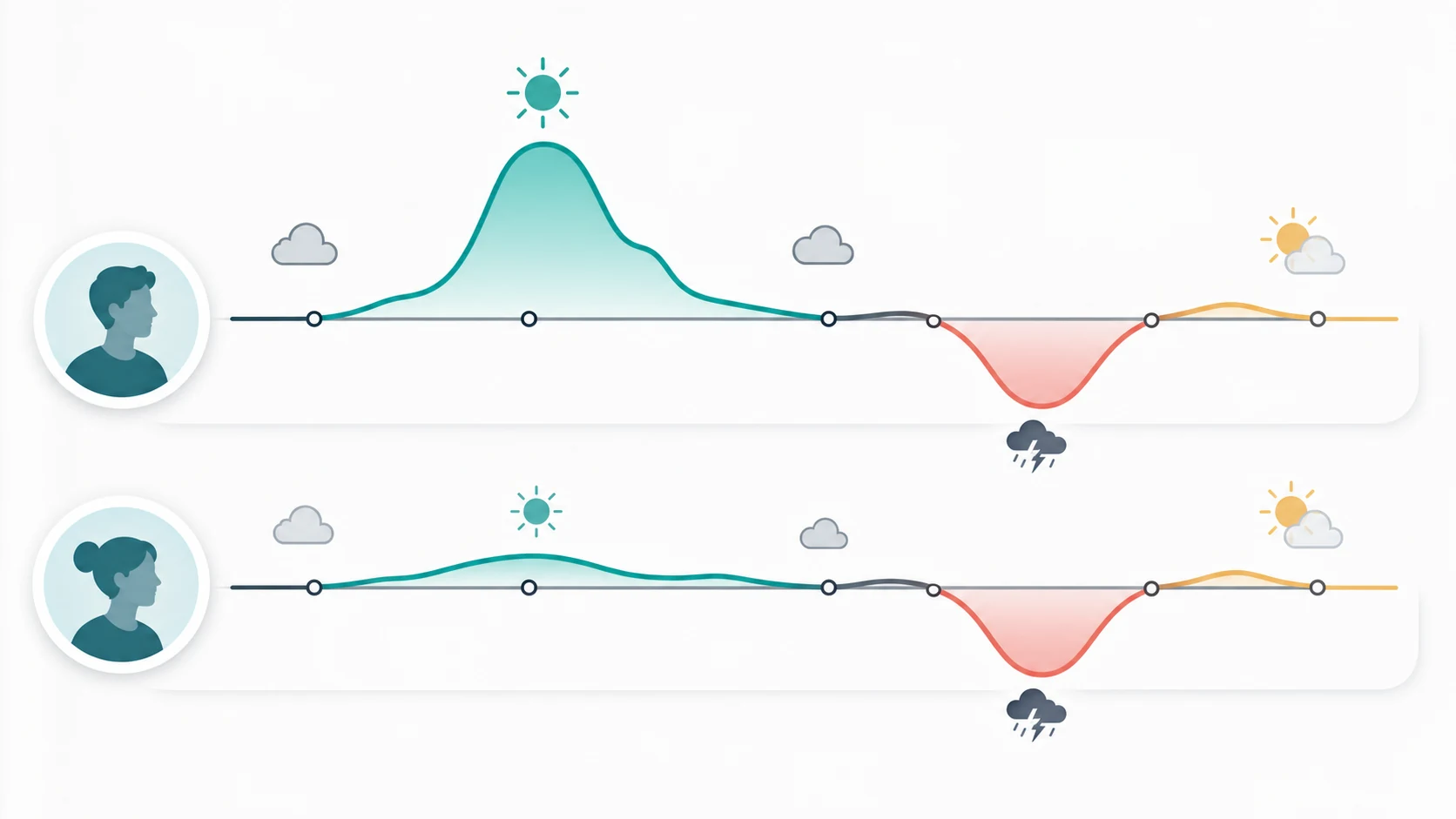
The phrase "DSM-5 bipolar 1 vs 2" usually points to one central difference: mania versus hypomania. Bipolar I requires at least one manic episode. Bipolar II requires at least one hypomanic episode and at least one major depressive episode, and there has never been a manic episode.
| Question | Bipolar I | Bipolar II |
|---|---|---|
| Required elevated episode | Manic episode | Hypomanic episode |
| Depression required? | No, though it is common | Yes, at least one major depressive episode |
| Psychosis during an elevated episode | Can occur in mania | Would point away from hypomania |
| Hospitalization from elevated mood | Can occur and supports mania | Not part of hypomania |
| Common confusion | May be remembered as "high highs" | May look like recurring depression until hypomania is explored |
Bipolar II is not simply a milder life problem. Hypomania is less severe than mania by definition, but bipolar II depression can be highly impairing. The distinction is about episode type and course, not about whether someone's suffering is "serious enough."
DSM-5 Criteria for Bipolar 2 What Searchers Often Miss
When people search "DSM-5 criteria for bipolar 2" or "DSM-5 bipolar 2 disorder criteria pdf," they often want the official list. A PDF or checklist can be useful for learning the vocabulary, but it can also create false certainty if used alone. Bipolar II depends on a lifetime pattern: at least one hypomanic episode, at least one major depressive episode, no manic episode, and symptoms that are not better explained by another psychotic disorder, substance effect, medication effect, or medical condition.
Three details are especially important.
First, hypomania must be a noticeable change from baseline. A person who is always talkative, ambitious, or energetic may not be having an episode just because those traits are present. The question is whether there was a distinct period when mood and energy shifted.
Second, impairment works differently. Mania causes marked impairment, hospitalization, or psychotic features. Hypomania does not. That is why someone can have risky choices or relationship strain during hypomania but still not meet the threshold for mania unless severity, safety risk, or psychosis changes the picture.
Third, depressive episodes often bring people into care. Someone may seek help for recurring depression without realizing that short periods of unusually high energy, reduced sleep, or impulsive activity are relevant. A careful timeline can make those patterns easier to discuss.
DSM-5 Bipolar Disorder Code and Psychotic Features
"DSM 5 bipolar disorder code" searches usually refer to the ICD codes printed alongside DSM categories and used in billing or records. Code choice depends on the specific condition, current or most recent episode, severity, remission status, and whether psychotic features are present.
Common examples include F31.81 for bipolar II disorder and F31.9 for unspecified bipolar disorder. Bipolar I-related F31 codes can vary by episode type: current episode hypomanic, manic, depressed, mixed, partial remission, full remission, with or without psychotic features, and by severity. For example, severe manic episodes with psychotic features and severe depressive episodes with psychotic features have different code paths than milder or unspecified presentations.
Psychotic features usually mean hallucinations, delusions, or other loss-of-reality experiences occurring during a mood episode. In bipolar I, psychotic features may occur during mania or depression and usually signal a more urgent clinical picture. In bipolar II, an elevated episode with psychosis is not considered hypomania; it points toward mania-level severity. Psychotic features can also be mood-congruent or mood-incongruent, a distinction a clinician may record because it can influence risk assessment and care planning.
If someone is having hallucinations, delusions, extreme agitation, very little sleep with unsafe behavior, suicidal thoughts, or a risk of harm, that is not a moment for self-sorting with a PDF. It is a reason to seek immediate professional or emergency support.

What a DSM-5 Bipolar Disorder Test Can and Cannot Do
A "DSM 5 bipolar disorder test" can be helpful when it is framed as screening or self-reflection. It may prompt you to notice patterns such as elevated energy, decreased need for sleep, impulsive choices, unusually fast speech, irritability, depressive periods, and changes others have observed. A Mood Disorder Questionnaire-based first step can help gather those reflections in a structured way.
What a test cannot do is apply the full DSM-5-TR framework by itself. It cannot rule out substance effects, medication effects, sleep deprivation, thyroid problems, trauma responses, ADHD, borderline personality disorder, major depression, schizophrenia spectrum conditions, or anxiety-related explanations. It also cannot weigh how symptoms unfolded across years, whether others observed the change, or whether safety risk is present.
The most useful output from a screener is not a label. It is a clearer conversation starter: dates, examples, sleep patterns, spending or risk changes, depressive periods, family history, and questions for a clinician.
Using DSM-5 Bipolar Disorder Information Safely
DSM-5 bipolar disorder information is most useful when it helps you describe patterns without rushing to a conclusion. If you are comparing bipolar I and II, reviewing bipolar II criteria, looking up codes, or wondering what psychotic features mean, keep the focus on evidence you can bring to a qualified professional.
A practical next step is to write down three types of information: elevated or irritable periods, depressive periods, and context. For each period, note approximate dates, sleep changes, energy level, risk-taking, spending, substance use, relationship impact, work or school impact, and whether someone else noticed the change. This kind of timeline often matters more than a single intense memory.
If you want a gentle way to organize your thoughts before an appointment, you can explore a confidential mood-pattern reflection and treat the result as educational context. Bring concerns to a licensed clinician, especially if symptoms are escalating, confusing, or affecting safety.
FAQ
Is there a DSM-5 bipolar disorder PDF?
There are educational PDFs and fact sheets about DSM-5-TR changes, but the full DSM text is copyrighted. Use reputable summaries to learn vocabulary, and rely on a qualified clinician for formal interpretation.
What are the main DSM-5 bipolar disorder symptoms?
The main symptom groups are manic symptoms, hypomanic symptoms, and depressive symptoms. DSM-5 looks at how they cluster into episodes, how long they last, and how they affect functioning.
What is the DSM-5 difference between bipolar 1 and 2?
Bipolar I requires at least one manic episode. Bipolar II requires at least one hypomanic episode and at least one major depressive episode, with no manic episode history.
What are the DSM-5 criteria for bipolar 2?
In plain English, bipolar II involves at least one hypomanic episode, at least one major depressive episode, no manic episode, and a careful review of other possible explanations.
What is the DSM-5 bipolar disorder code?
There is no single code for every bipolar presentation. Bipolar II is commonly listed as F31.81, while bipolar I-related F31 codes vary by current or most recent episode, severity, remission, and psychotic features.
What does bipolar disorder with psychotic features mean?
It means psychotic symptoms, such as hallucinations or delusions, occur during a mood episode. This should be evaluated promptly by a mental health professional, especially if safety is a concern.