Is Bipolar Disorder a Disability? A Guide to ADA Rights and SSA Benefits
Living with bipolar disorder can feel like navigating a storm without a compass. Beyond the emotional and physical challenges, you likely face practical questions about your job security and financial stability. Whether you are just beginning to recognize the signs of bipolar disorder or have managed the condition for years, understanding your legal standing is crucial.
The short answer is yes—bipolar disorder is a recognized medical condition that can qualify as a disability. However, the legal definition of "disability" varies significantly depending on whether you are seeking workplace protection or applying for financial benefits. This guide breaks down these complex legal distinctions into clear, actionable information. We will explore your rights under the ADA, the strict criteria for SSA benefits, and how to effectively document your condition.

The Two Legal Definitions: Workplace Rights vs. Financial Benefits
One of the most common sources of confusion is the difference between being "disabled" in the eyes of your employer and being "disabled" according to the Social Security Administration (SSA). You might qualify for protection at work but still be denied monthly disability checks. Understanding this distinction is your first step toward advocacy.
Civil Rights (ADA): Protection for Your Job
Under the Americans with Disabilities Act (ADA), a disability is defined as a physical or mental impairment that substantially limits one or more major life activities.
- The Bar is Lower: You do not need to prove you are unable to work. In fact, the ADA protects you because you can work, provided you have reasonable accommodations.
- The Goal: To prevent discrimination and ensure equal opportunity in the workplace.
- Key Takeaway: If bipolar disorder affects your sleep, concentration, or ability to regulate emotions, you are likely protected under the ADA.
Disability Benefits (SSA): Financial Support for Inability to Work
The Social Security Administration (SSA) uses a much stricter definition for SSDI (Social Security Disability Insurance) and SSI (Supplemental Security Income).
- The Bar is Higher: You must prove that your medical condition is so severe that you cannot perform any substantial gainful activity (SGA) and that this condition is expected to last at least 12 months or result in death.
- The Goal: To provide income replacement for those who are medically unable to work.
- Key Takeaway: Having a diagnosis is not enough. You must prove functional limitations that prevent you from holding a job.
Is Bipolar Disorder a Disability Under the ADA?
For many, the immediate concern is job security. You might worry about erratic behavior during a manic episode or low productivity during depression. The ADA offers robust protections to help you maintain employment while managing your health.
Protection Against Discrimination and Harassment
Is bipolar disorder considered a disability under the ADA? Yes. This means it is illegal for an employer with 15 or more employees to discriminate against you based on your diagnosis.
- Hiring: They cannot refuse to hire you solely because you have bipolar disorder.
- Firing: They cannot fire you for having a medical condition (though they can still fire you for performance issues if no accommodation was requested).
- Harassment: You have the right to a workplace free from offensive remarks about mental illness.
Do You Have to Disclose Your Condition? (Privacy Rights)
This is a critical decision. You are not legally required to disclose your bipolar disorder to your employer unless you are asking for a reasonable accommodation.
- If you do not need accommodations: You can keep your diagnosis private.
- If you need accommodations: You must disclose enough information to show that you have a disability and need a change in the work environment. You do not always need to share your full medical file, but you must establish the link between your condition and the request.
Examples of Reasonable Accommodations at Work
Reasonable accommodations are adjustments that allow you to perform your essential job duties. They are not "special treatment" but rather tools for equity.
Common accommodations for bipolar disorder include:
- Flexible Scheduling: To accommodate therapy appointments or medication side effects (e.g., morning grogginess).
- Remote Work Options: Allowing you to work from home on days when symptoms are flaring up, reducing social stress and sensory overload.
- Reduced Distractions: Noise-canceling headphones or a workspace away from high-traffic areas to help with concentration.
- Written Instructions: Receiving tasks via email rather than verbally to aid memory during brain fog.
- Meeting Adjustments: Permission to record meetings or bring a support person if social anxiety or memory issues are high.
- Leave of Absence: Unpaid leave during a hospitalization or severe episode (which may also fall under FMLA).
Qualifying for Social Security Disability (SSDI & SSI)
When symptoms become debilitating, you may need to consider disability benefits. Is bipolar disorder a disability for Social Security? Yes, but approval is notoriously difficult. The SSA evaluates claims based on a specific set of medical criteria known as the "Blue Book."
Meeting the "Blue Book" Listing 12.04 Criteria
To qualify under Listing 12.04 (Depressive, Bipolar and Related Disorders), you generally need to provide medical documentation satisfying two main parts:
-
Paragraph A (Medical Documentation): You must have a history of persistent depressive or manic syndromes characterized by specific symptoms (e.g., flight of ideas, inflated self-esteem, sleep disturbance, loss of interest).
-
Paragraph B (Functional Limitations): This is often the hurdle where claims fail. You must prove an "extreme" limitation in one, or a "marked" limitation in two, of the following areas:
-
Understand, remember, or apply information.
-
Interact with others.
-
Concentrate, persist, or maintain pace.
-
Adapt or manage oneself.
-

Real-World Examples of "Functional Limitations"
Legal terms like "adapt or manage oneself" can be vague. Here is what they look like in daily life:
- Interact with others: Do you have a history of altercations with supervisors? Do you isolate socially to avoid conflict?
- Concentrate, persist, or maintain pace: Do you start tasks but never finish them? Do you require extra supervision to stay on track?
- Adapt or manage oneself: Do you neglect personal hygiene during depressive episodes? Do you engage in risky behavior (spending, speeding) during manic phases that threatens your safety?
- Understand, remember, or apply information: Do you frequently forget instructions or struggle to learn new procedures at work?
Navigating the Evidence Gap: From Symptoms to Documentation
The gap between knowing you are disabled and proving it to the SSA is bridged by one thing: evidence. Your subjective experience of pain or confusion is valid, but the legal system requires objective proof.
Why Medical Records Are Your Strongest Asset
A diagnosis letter from your doctor is rarely enough. The SSA needs to see a longitudinal history—a story told through medical records over time.
- Consistency: Regular visits to a psychiatrist or therapist show that your condition is chronic.
- Treatment Response: Records should detail that you have tried various medications or therapies and still experience disabling symptoms.
- Doctor's Notes: Specific observations (e.g., "Patient appeared disheveled and psychomotor retarded") carry more weight than general statements.
Using Structured Screening to Communicate with Your Doctor
Doctors are busy, and appointments are short. It can be hard to remember every mood swing or symptom trigger when you are sitting in the exam room. Yet, these details are exactly what build a strong disability case.
If you struggle to articulate the severity of your highs and lows, using a structured tool can help. You can try the bipolar disorder test on our platform as a starting point. This free, confidential tool is based on the Mood Disorder Questionnaire (MDQ).
It is not a diagnosis, but it provides a personalized report that organizes your symptoms into a clear format. You can print this report and take it to your next appointment. It acts as a conversation starter, helping you and your doctor ensure that your medical records accurately reflect the full scope of your daily challenges.
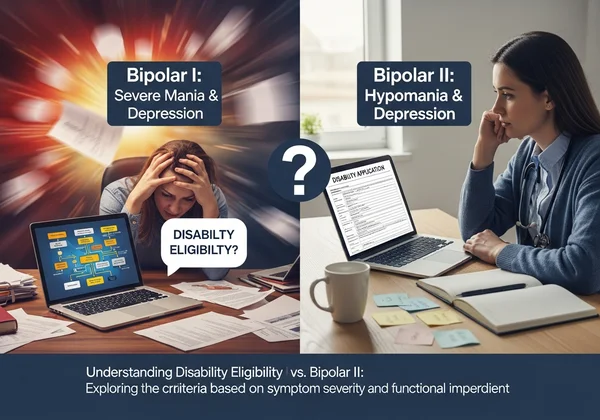
Does Bipolar 1 vs. Bipolar 2 Affect Eligibility?
A common myth is that only Bipolar 1 (with full mania) qualifies for disability, while Bipolar 2 (hypomania and depression) does not. This is false.
Understanding Severity Beyond the Label
Is Bipolar 1 a disability? Yes. Is Bipolar 2 disorder a disability? Also yes. The SSA does not grant benefits based on the "type" label but on the severity of the symptoms.
- Bipolar 1: Often involves hospitalization for mania, which creates a clear paper trail of severity.
- Bipolar 2: The primary disabling factor is often the crushing, treatment-resistant depression. While hypomania might not seem "disabling" on paper, the depressive crashes can make consistent work impossible.
Why Functional Impairment Matters More Than Diagnosis
You could have Bipolar 1 and be stable on lithium, working full-time. You could have Bipolar 2 and be unable to get out of bed for weeks at a time.
-
Focus on Impact: Don't worry if your diagnosis label has changed over the years. Focus on documenting how your current symptoms stop you from working.
-
Cyclothymia: Even milder forms like cyclothymia can qualify if the emotional volatility significantly impacts your ability to perform work tasks consistently.
Taking the First Step Toward Recognition and Support
Navigating the world of disability rights is exhausting, especially when you are already managing a mental health condition. Remember that these laws exist to protect you. Whether you are asking for a quieter desk at work or applying for SSDI benefits, you are exercising your civil rights.
Your Pre-Application Checklist:
- Self-Assess: Understand your symptom patterns. Consider using our bipolar disorder test online to gain clarity on your traits.
- Consult: Talk to your doctor about your intent to apply. Ask if they support your claim.
- Gather: Collect contact info for all doctors, therapists, and hospitals you’ve visited in the last few years.
- Journal: Start a daily log of how your symptoms limit your activities (e.g., "Could not cook dinner due to fatigue").
You don't have to navigate this alone. Armed with the right information and accurate documentation, you can advocate for the support you deserve.
Frequently Asked Questions
What are the chances of getting disability for bipolar disorder?
Approval rates vary, but initial applications for mental health conditions are often denied (some estimates suggest nearly 60-70% are denied initially). However, many people successfully win benefits during the appeals process, especially with legal representation.
Why are bipolar disability claims often denied?
The most common reason is lack of medical evidence. If you have gaps in treatment, do not take prescribed medication, or if your medical records do not specifically describe functional limitations (like inability to concentrate), the SSA may assume your condition is not severe.
Does bipolar disorder qualify for FMLA leave?
Yes. The Family and Medical Leave Act (FMLA) allows eligible employees to take up to 12 weeks of unpaid, job-protected leave for serious health conditions, including bipolar disorder. This is different from permanent disability; it is designed for short-term crises or hospitalization.
How long does it take to get approved?
The process is slow. An initial decision typically takes 3 to 6 months. If you are denied and have to appeal, it can take over a year to get a hearing. It is crucial to apply as soon as you stop working.
Can I work part-time while receiving benefits?
Yes, but with strict limits. The SSA looks at "Substantial Gainful Activity" (SGA). In 2024, if you earn more than $1,550 per month, you are generally considered "able to work" and ineligible for full disability benefits. Always check the current year's SGA limits.