Understanding Bipolar Disorder: Brain Chemistry, Testing & Latest Research
If you've ever wondered what's happening in your brain during extreme mood swings, you're not alone. Scientists have been asking these same questions for decades, and what they've discovered can help make sense of your experiences. Many people spend years trying to figure out why their energy levels and emotions shift so dramatically. Why does my mood change so quickly? This is a question that researchers and patients alike have been asking for decades. For those experiencing these fluctuations, the biological reasons can feel like a deep mystery.
Understanding the "why" behind your experiences is a powerful step toward feeling better. This article demystifies the scientific landscape of bipolar disorder. We will explore brain chemistry, genetic factors, and what modern brain scans actually show. Our goal is to provide clear knowledge without overwhelming you with complex medical jargon. If you are looking for clarity, using a bipolar screening tool can help you connect these scientific facts to your personal journey.
By learning about the biology of bipolar disorder, you can move from confusion to insight. This knowledge helps you talk more effectively with doctors and reduces the stigma often associated with mental health. Researchers have made remarkable breakthroughs in understanding bipolar disorder in recent years. What they've found offers hope and practical insights for those navigating these mood fluctuations. Let’s dive into what is actually happening inside the human brain.
How Bipolar Testing Relates to Brain Chemistry
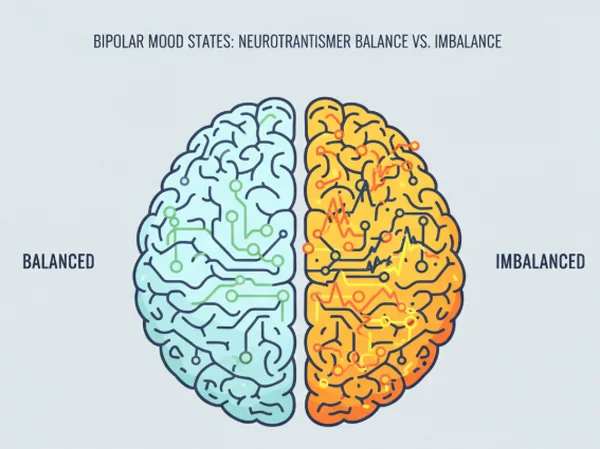
At the heart of the "biological" explanation for bipolar disorder is the study of bipolar disorder brain chemistry. Our brains rely on a complex web of chemicals to send messages between neurons. These chemicals are called neurotransmitters. Think of them as the brain's internal communication system. In a brain affected by bipolar disorder, this communication system sometimes experiences "glitches" or imbalances.
The Role of Key Neurotransmitters: Serotonin, Dopamine, and Norepinephrine
Three primary neurotransmitters play the biggest roles in regulating our moods: serotonin, dopamine, and norepinephrine. When these chemicals are not balanced, it can lead to the extreme highs and lows associated with the condition.
- Dopamine: This is often called the "reward" chemical. It is linked to energy, motivation, and pleasure. Research suggests that during a manic episode, dopamine levels may be too high. This leads to that "invincible" feeling, racing thoughts, and high energy. During depressive phases, the brain essentially experiences a chemical drought. This makes even simple tasks feel overwhelming.
- Serotonin: This chemical helps regulate sleep, appetite, and overall mood stability. Low levels of serotonin are strongly linked to the "lows" or depressive phases. When serotonin is low, it becomes much harder for the brain to maintain a stable emotional baseline.
- Norepinephrine: This chemical is involved in the "fight or flight" response. It affects how we react to stress. An oversupply of norepinephrine can contribute to the irritability and anxiety often seen in manic or mixed episodes.
How Neurotransmitter Imbalance Manifests in Different Bipolar Phases
The way these chemicals interact changes depending on whether a person is in a manic, hypomanic, or depressive state. During mania, the brain is essentially "overclocked." The high levels of dopamine and norepinephrine drive the person toward goal-oriented activities. However, it also drives them toward impulsivity. The brain’s reward system is working overtime, making even risky behaviors seem like a great idea.
In contrast, the depressive phase feels like the system has shut down. With low levels of dopamine and serotonin, the world can feel gray and heavy. Even simple tasks like getting out of bed feel impossible because the "motivation" chemicals are in short supply. If you feel like your energy is constantly shifting between these two extremes, taking a bipolar test might help you identify if these patterns are consistent with a clinical mood disorder.
The Science Behind Bipolar Assessment
One of the most frequent questions people ask is: "Is bipolar disorder passed down through families?" The short answer is yes, but it is not as simple as a single "bipolar gene." Current research on bipolar disorder genetics shows that many different genes work together to increase a person's risk.
Identifying Genetic Markers Linked to Bipolar Disorder
Scientists have identified several genetic markers that are more common in people with bipolar disorder. These markers are often related to how the brain moves calcium in and out of cells. They can also relate to how the brain develops new neural pathways. However, having these markers does not guarantee that someone will develop the condition.
Instead, genetics provide a "vulnerability." You might be born with a higher risk, but environmental factors often act as the "trigger" that starts the first episode. These factors include extreme stress, trauma, or lack of sleep. This is why some people with a family history never develop the disorder, while others do.
Family History and Risk Assessment
Family history is the strongest known risk factor for bipolar disorder. If a parent or sibling has the condition, your chances of having it are higher than the general population. However, it is important to remember that most children of parents with bipolar disorder do not develop it.
Risk assessment is about looking at the big picture. Doctors look at your family tree, but they also look at your personal history of mood swings and energy. Understanding your family history can be a helpful piece of the puzzle. If you are concerned about your own patterns, using an online test can provide a private way to start checking your symptoms against established clinical criteria.
Neuroimaging and Brain Structure in Bipolar Disorder
In the past, we could only guess what was happening in the brain by looking at behavior. Today, thanks to bipolar disorder neuroscience, we can actually see the brain in action. Neuroimaging, such as MRI and PET scans, has revealed that the brains of people with bipolar disorder often look and function differently.
What Brain Scans Tell Us About Bipolar Brains
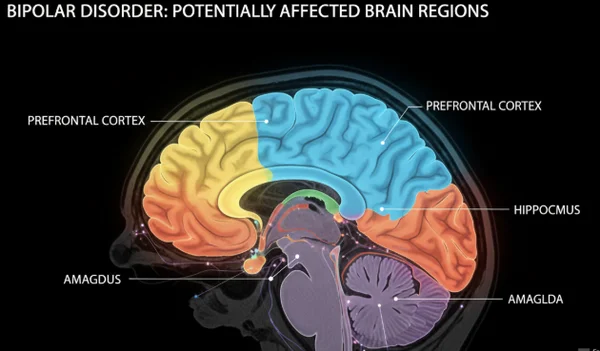
Brain scans show that in people with bipolar disorder, certain areas of the brain may have different volumes or shapes. For example, some studies have found that the hippocampus may be slightly smaller in those who have had many depressive episodes. This is the part of the brain responsible for memory and emotion.
Scans also show that the "gray matter" in the brain can be thinner in areas that control impulses. Gray matter is responsible for processing information. This physical difference helps explain why it is so difficult to "just stop" a manic episode. The brain’s physical structure makes it harder to regulate those intense feelings.
Brain Circuitry and Emotional Regulation
It is not just about the size of brain parts; it is about how they talk to each other. This is called brain circuitry. In a healthy brain, the "prefrontal cortex" acts like a brake for the "amygdala." The prefrontal cortex is the logical part, while the amygdala is the emotional part. When you feel angry or sad, the logical part tells the emotional part to calm down.
In a bipolar brain, this "braking system" is often weak. The emotional center of the brain reacts very strongly to small things. Meanwhile, the logical center cannot easily turn it off. This creates an emotional roller coaster. Understanding that this is a physical issue with brain circuitry can be incredibly validating. It helps people see that they aren't failing at "controlling" their emotions.
Current Research and Emerging Treatments
The field of bipolar disorder research is moving faster than ever. We are moving away from "one-size-fits-all" treatments toward more personalized care. This brings a lot of hope to those who have struggled with traditional medications.
Novel Medications and Their Mechanisms
For years, lithium has been the gold standard for treatment. While lithium is still very effective, researchers are now looking at new medications that target different pathways. Some of these newer drugs focus on glutamate. This is another neurotransmitter that helps regulate how brain cells communicate.
Others are looking at "neuroprotective" drugs. These are medications designed to protect the brain from damage that can occur during repeated episodes. The goal of bipolar disorder new treatments is not just to stop the symptoms. Scientists want to keep the brain healthy over the long term.
Innovative Therapeutic Approaches Beyond Medication
Medicine is not the only way to treat the brain. New research is showing success with:
- Social Rhythm Therapy: This focuses on stabilizing daily routines like sleep, eating, and exercise. This keeps the brain’s internal clock in sync.
- Neuromodulation: Techniques like Transcranial Magnetic Stimulation (TMS) use magnetic fields. These stimulate specific areas of the brain involved in mood regulation.
- AI-Driven Insights: Artificial intelligence is now being used to analyze mood patterns. This can help predict when an episode might be starting.
Our website utilizes some of this modern technology by offering an AI personalized report after you complete our screening tool. This report helps you look deeper into your unique patterns, providing a more modern approach to self-understanding.
Moving From Scientific Understanding to Personal Insight
Science has made incredible progress in unravelling the complexities of bipolar disorder. We now know that it is a physical condition involving neurotransmitter imbalances, genetic vulnerabilities, and specific changes in brain circuitry. It is not a character flaw or a lack of willpower; it is a complex biological reality.
However, scientific facts are most useful when you apply them to your own life. Every person’s experience is unique. While the research gives us a general map, your personal patterns are the key to finding the right path forward. If you have recognized yourself in the descriptions of energy shifts or mood regulation struggles, don't wait to find out more.
Taking the first step toward clarity is easy. Our scientifically-grounded screening tool is designed to help you. It is based on the DSM-5 and the Mood Disorder Questionnaire (MDQ). You can start your test today to get instant insights and an optional AI-powered report. This information can be a vital resource for you to share with a healthcare professional, helping you move from wondering to knowing.
The Takeaway
What is the latest research on the genetic basis of bipolar disorder?
Current research is focusing on "polygenic risk scores." This means scientists are looking at hundreds of tiny genetic variations rather than one single gene. Recent studies suggest that bipolar disorder shares some genetic roots with schizophrenia and major depression. However, it also has unique markers related to the brain's "circadian rhythms." This is why sleep is so important for management.
How do medications for bipolar disorder affect brain chemistry?
Most medications work by stabilizing neurotransmitters. For example, mood stabilizers help prevent the "over-firing" of neurons that leads to mania. Antidepressants try to increase serotonin levels, though they are usually used carefully alongside stabilizers. The goal is to create a "buffer" so that your brain's chemistry doesn't swing too far in either direction. To see if your symptoms align with these patterns, you can take the test online.
Can neuroimaging definitively diagnose bipolar disorder?
No, brain scans are not yet used for clinical diagnosis in a doctor's office. While they show differences in groups of people with bipolar disorder, there is too much individual variation for a scan to be a "yes/no" test for one person. Diagnosis is still based on your clinical history, symptoms, and behavior patterns.
What emerging treatments show promise for bipolar disorder?
Beyond new medications, "digital therapeutics" are showing great promise. These are apps and AI tools that track your sleep and activity levels. They can warn you before a mood shift happens. There is also ongoing research into the gut-brain connection and how diet and inflammation might play a role in mood stability.
Disclaimer: The information in this article is for educational purposes only and is not a substitute for professional medical advice, diagnosis, or treatment. Always seek the advice of your physician or other qualified health provider with any questions you may have regarding a medical condition.